
How much does home heating cost in NZ?
Heating your home in New Zealand isn’t just about staying warm—it’s a long-term financial decision. The upfront price of a heater can be misleading, because the real cost shows up over the years of running it.
This guide breaks down the true cost of home heating in NZ, comparing five common technologies:
Electric heat pumps
Gas-flued heaters
LPG flued heaters
Wood fires
Resistive electric heaters
1. Upfront and Installation Costs
The initial cost varies widely depending on the system. Most homes need two units for full coverage (except wood fires, which typically need only one).
| Heating Technology | Unit Cost (Average) | Installation Cost (Average) | Total Upfront (per unit) |
|---|---|---|---|
| Electric Heat Pump | $3,800 | $1,050 | $4,850 |
| Gas Flued Heater | $3,200 | $1,250 | $4,450 |
| LPG Flued Heater | $3,300 | $1,250 | $4,550 |
| Wood Fire | $3,950 (incl. flue) | $1,000 | $4,950 |
| Resistive Bar Heater | $300 | $0 (plug-in) | $300 |
What this means:
Resistive heaters look cheapest upfront, while heat pumps and wood fires sit at the higher end. But upfront cost is only part of the story.
2. Annual Operating (Running) Costs
Running costs depend on fuel price + efficiency. This is where things start to shift dramatically.
Electric Heat Pump (with 30% Solar): $183/year
Electric Heat Pump (Grid only): $235/year
Wood Fire: $589/year
Gas Flued Heater: $794/year (includes fixed/proportional gas bills)
LPG Flued Heater: $1,080/year (includes fixed/proportional gas bills)
Resistive Electric Heater: Higher than heat pumps due to lower efficiency (exact figure not listed)
Key takeaway:
Heat pumps cost about 3× less to run than gas heating.
3. Total Lifetime Cost (15-Year Comparison)
When you combine purchase, installation, and 15 years of energy bills, the full picture becomes clear:
Heat pump (with solar & grid): $10,815
Heat pump (grid only): $11,805
Wood fire: $13,848
Resistive electric: $15,318
Gas heating: $20,608
LPG heating: $26,396
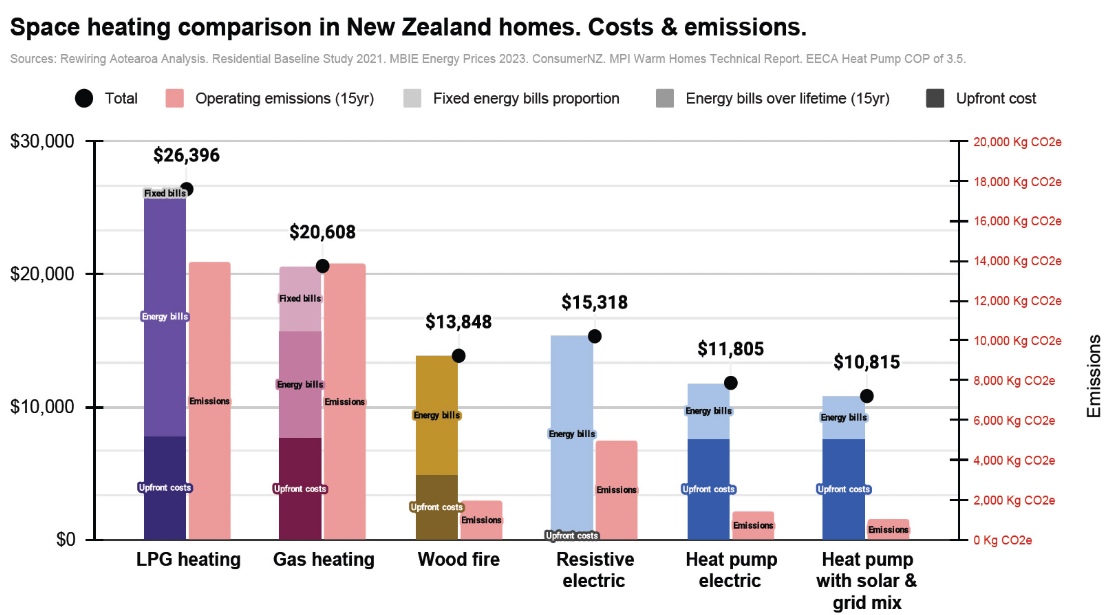
The data is from Rewiring Aotearoa’s Report.
What stands out:
Even though heat pumps aren’t the cheapest upfront, they are the cheapest overall by a wide margin.
Why the Costs Differ: Energy Efficiency
The biggest factor behind these differences is efficiency—how much heat you get per unit of energy.
Heat pumps (~350% efficient):
They don’t create heat—they move it. This makes them incredibly efficient.Resistive electric heaters (~100% efficient):
All electricity turns into heat, but no efficiency gain beyond that.Gas heaters (75–85% efficient):
A portion of the heat is lost through flues.Wood fires (55–75% efficient):
Significant heat escapes up the chimney.
The Bottom Line
If you’re only looking at upfront cost, cheaper options like resistive heaters or gas systems might seem appealing. But over time, they can cost thousands more.
Heat pumps strike the best balance:
Moderate upfront cost
Lowest running cost
Lowest total lifetime cost
All the data above are from Rewiring Aotearoa’s Electric Homes Report.
According to the report, the summary is: Electric heat pumps are the most cost-effective and energy-efficient space heating option for New Zealand homes. While some alternatives have lower upfront costs, the superior efficiency of heat pumps results in the lowest total cost over the appliance's lifetime.
FAQ:
1. What is the cheapest way to heat a home in NZ?
Answer:
Electric heat pumps are the cheapest way to heat a home in New Zealand over time due to their high efficiency and low running costs.
2. Are heat pumps cheaper than gas heating in NZ?
Answer:
Yes, heat pumps cost around three times less to run than gas heating in New Zealand, making them significantly cheaper over their lifetime.
3. What is the cheapest heater upfront in NZ?
Answer:
Resistive electric heaters have the lowest upfront cost, but they are more expensive to run compared to heat pumps.
4. Why are heat pumps more efficient?
Answer:
Heat pumps are around 350% efficient because they move heat instead of generating it, unlike electric or gas heaters.
Approved by Technical Engineer: Brian
7th Jul 2026